
Eating Mulberries
- liangachun
- Jan 29
- 5 min read
Shaanxi Association of Canada
Du Yunfeng
January 25, 2026
One of humanity's defining traits is sociality, where interaction forms the fundamental element. Everything that unfolds in social engagement carries an inherent inevitability, a kind of karmic connection. Some bonds form through shared schooling, others through shared neighborhood. Some even begin as adversaries—perhaps through a fight—only to become friends later. In short, all possibilities exist, and every factor has its intrinsic reason.
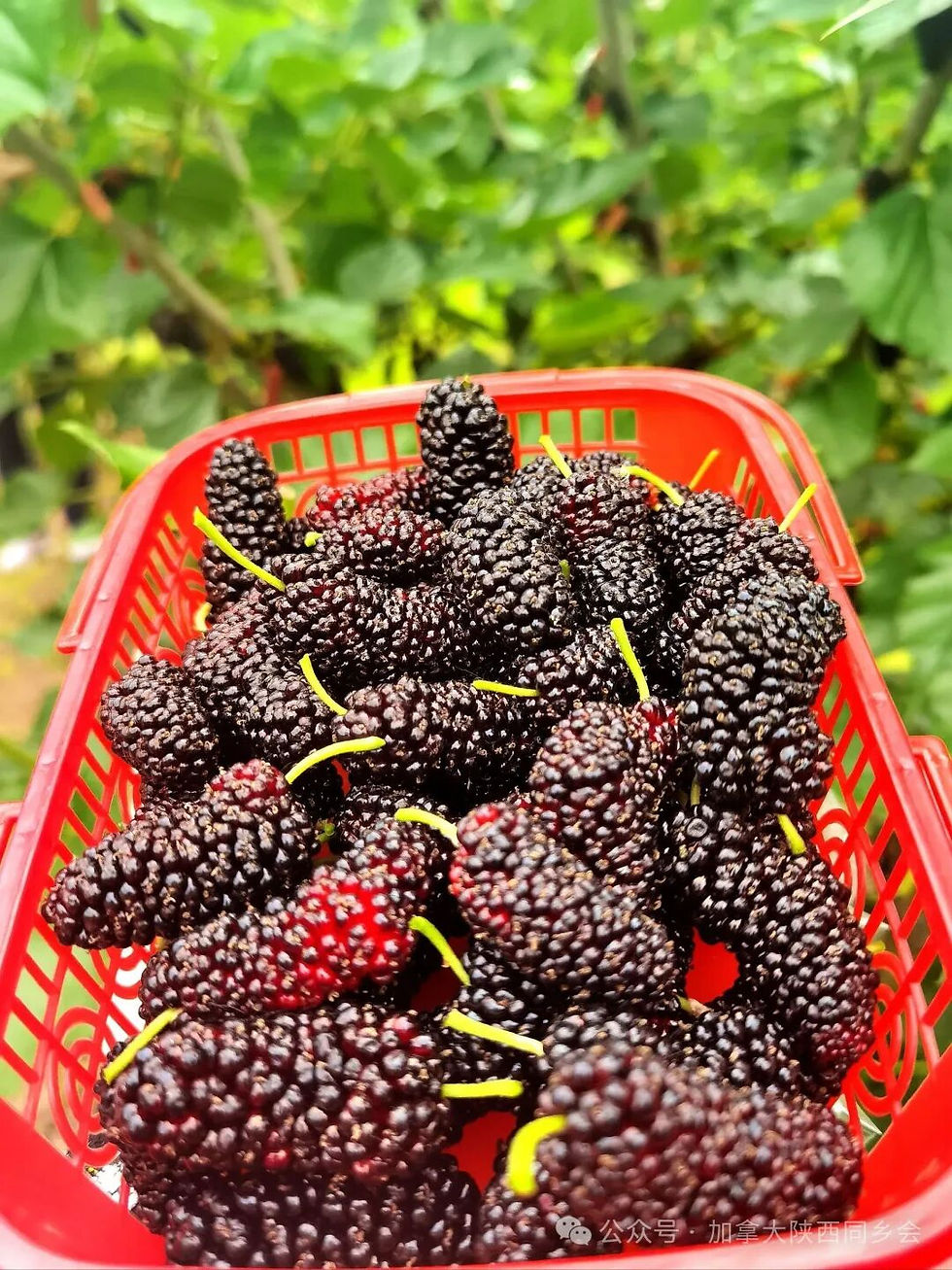
Mulberries have brought me many friends, who have gradually become dear companions. Mulberries, known as mulberry fruits in Shaanxi's countryside. Each midsummer, mulberry trees become laden with fruit—deep purple, clustered densely, yet shyly hidden behind leaves, reluctant to be seen. These are the ripe mulberries. Medical texts state: Mulberry fruit, also called mulberry, nourishes yin and replenishes blood, deeply nourishing the body. Food and medicine share the same origin.

Children know nothing of medicine books, only that it tastes good—tart and sweet. When I was six or seven, I loved raising silkworms and often asked my mother for five cents to buy mulberry leaves. After buying them so many times, the old man selling mulberry leaves remembered me and never forgot to grab a few mulberries for me each time I went. Popping one into my mouth, I'd gently bite down. The tangy-sweet flavor would dance across my taste buds, and cool, refreshing juice would flow down my throat—delicious. I'd even smack my lips afterward, savoring the lingering taste for a long while. My love for mulberries meant I raised silkworms every year, ensuring I could enjoy them season after season. Gradually, whenever the weather turned hot, I'd start thinking about raising silkworms and eating mulberries. Just the thought of mulberries would make my mouth water, and I'd swallow hard. Later, when I started working, I was always busy and stopped raising silkworms. The joy of eating mulberries faded away. Then came marriage and parenthood. My daughter grew up and started elementary school. One day, she brought home several silkworms from school—plump and white, dotted with spots. She called them tiger silkworms, a rare new breed. Since she loved them, I took them in. Year after year, they multiplied until I had several baskets full. Their droppings alone filled a pillow of decent size. My colleague Zhang Xiaoguang had just celebrated his first wedding anniversary and welcomed a child. He heard from elders that a pillow stuffed with silkworm droppings was especially beneficial for infants, though hard to come by. Learning I had one, he visited and earnestly requested the pillow. From then on, we became close friends, visiting each other year after year like relatives, until I moved abroad.
With so many silkworms, mulberry leaves became a problem. Chinese tradition advises against planting mulberry trees in front of homes, willows behind them, or ghost-clapper trees near entrances, so few households grow mulberry trees. To gather mulberry leaves, I scoured every corner of Xi'an, eventually discovering a farmhouse near the Baqiao Thermal Power Plant in the eastern suburbs where they grew. The farmer, surnamed Li and two years my senior, became my friend Li. When he learned I gathered leaves to feed silkworms for my children, he generously allowed me to take as many as I needed. Each visit yielded a large bag enough to sustain my silkworms for weeks back in Xi'an. Summer heat made mulberry leaves hard to store. I lived in the Publishing Compound at North First Street, where a large vacant lot existed. The compound director specially permitted me to dig a cellar in a corner. I stored mulberry leaves there in summer, while neighbors stored cabbages and radishes in winter. Everyone benefited, so instead of complaints, I earned gratitude for digging the cellar.

As seasons passed, Brother Li and I became friends. Each visit found him with a meal ready, insisting I eat. After dinner, over tea and conversation, he’d always place a large bowl of mulberries on the table for us to snack on freely. Before I left, he’d pack some for me, saying, “Let your children try them too.” Of course, I brought gifts—often a pack of Baocheng cigarettes. Rural folk usually smoked pipe tobacco, so Baocheng cigarettes were a rare treat. He often used them to entertain guests, always adding, “These are from a city friend.” Before long, farmers across dozens of miles around Dongjiao and Baqiao knew my name. During festivals, we'd gather to drink, feast, play drinking games, and have a splendid time! Farmers are the easiest people to get along with—open-hearted and straightforward. So, more and more farmer friends came to know me, like relatives, visiting often. Now that I've settled in Canada, I always visit them whenever I return to China, staying in Baqiao for several days. They love the gifts I bring, and even though they've become quite wealthy from relocation compensation, they still cherish my visits. After I leave, they always call relatives and friends over to show off the gifts, boasting for hours: “This is from my Canadian friend! Try some!”
I immigrated to Canada in April 2011. Soon after arriving, it was mulberry season. Foreigners don't follow the old saying about not planting mulberry trees in front or willows behind, so mulberry trees line their doorsteps and roadsides. The older immigrants took me mulberry picking. Freshly picked and eaten right away, the berries tasted even sweeter. Through frequent visits, I met Jack. His house wasn't far from mine. He was a Westerner living in a very luxurious mansion. Mulberry trees lined his front road and courtyard—several of them. Knowing my fondness for them, he'd call and invite me over when the mulberries ripened. I'd bring Chinese tea and various Shaanxi delicacies, teaching him how to brew the tea and savor the dishes—how to tear the bread for roujiamo, prepare liangpi, and mix the chili sauce for yangrou paocai. We sipped tea, chatted, and ate mulberries together, our conversation flowing freely and our spirits high. Though my English isn't perfect, we communicated through gestures and he grasped the gist, making the atmosphere even livelier. When the conversation grew particularly animated, I demonstrated some boxing moves for him. He took an instant liking to it, immediately asking me to teach him and wanting to take me as his master. And so, I gained another foreign disciple. He especially loved Tai Chi, constantly praising my movements as graceful and full of rhythm. He thanked me, saying that since meeting me and learning Tai Chi, his health had improved and life had become more flavorful. He declared Chinese martial arts truly wonderful, Chinese tea incredibly fragrant, and the food delicious. He confessed his growing affection for China, viewing me as a god-like figure.


Comments